Friday March 9, 2012
When my plans to visit Afghanistan were cancelled at the last minute I needed another destination accessible from Dubai as a replacement. Multiple people suggested Oman, so I paid a hastily organised six day visit.
Oman is on the eastern side of the Arabian peninsula. The country has executed a remarkable turnaround in its fortunes in recent times. A generation ago it was one of the least developed in the world, with no high schools and only two primary schools [thanks to the Lonely Planet for that fact]. The locals have termed the current period a "renaissance" as it now boasts monetary wealth, terrific public infrastructure, and a highly educated population - all while retaining its traditions and culture.
Politically Oman is considered the most stable nation in the Middle East, with the Sultan famous for his "listening tours" of the country. He seems to enjoy genuine affection from his subjects for all that he has achieved in the past forty years.
The capital Muscat had always been a popular stopover for passing cruise ships, but the rest of the country has recently become accessible to tourists thanks to a network of new roads. It was eye-opening how many new expressways were being built.
From my previous visits to the Middle East the prospect of driving frightened me no end. However Oman is a sparsely populated country with many attractions being in remote areas - similar to Australia. Hiring a car made sense.
I'm glad to report driving in Oman was a pleasure. The drivers are certainly more civil than other countries in the region - just next door in the United Arab Emirates I live in fear as a pedestrian, let alone a motorist - and due to the low population once you're outside Muscat there is hardly any traffic on the expressways.
In racking up 1000km in five days I managed to visit three regions - Muscat, Nizwa, and Sur.
MUSCAT
Muscat is city that is located in a strategically vital location - at least in ancient times - at the mouth of the Persian Gulf, where the Middle East meets Asia. Both for trade and diplomatic purposes Muscat was a city frequently visited by foreign ships.
In Muscat there is a glitzy, beachy part where all the luxury hotels and most of the tourists seem to be. I, of course, chose to stay in the old town - Muttrah; a beautiful harbour overlooked by old forts with a busy old souq (market), a lively morning fish market, and flanked by a lovely corniche.
However, this harbour, with its shipping facilities, also hosts the numerous cruise liners that stop by in Muscat. Hence in the middle of the day there are many sunburnt Europeans getting about in inappropriately skimpy summer outfits (Omanis are too polite to tell them to cover up!) enjoying the corniche and the souq. On the first day I saw many middle aged British men giggling as they tried on traditional Arabic dress in the markets, then just as fast as they appeared they were all gone; back on the ship for their next destination.
SUR
Sur is a regional city close to the eastern tip of the Arabian peninsula. The newly built expressway from Muscat - which is so fresh the toll gates were not even manned - takes a gorgeous route along the coast. As strange as this sounds the scenery reminded me of Iceland; steep uninhabitable mountains on one side and the beautiful sea on the other, with the road wedged in between.
About 40km outside of the town, even closer to the eastern tip, is the Ras al Jinz turtle reserve. Green turtles return from all around the Indian Ocean to lay their eggs here in the middle of the night. Amazingly almost everyday this beach hosts at least one mother turtle. Our group was fortunate enough to see the entire act - laying eggs, burying them, and waddling back out to the sea. Unfortunately for the dignity of the mother turtle the guides shone torchlight up its cloaca so that we could witness the egg laying. Well, I suppose people film human births in hospitals these days.
There were also tiny baby turtles, just hatched, making their perilous first journey out to sea. If it weren't for the fascinated tourists scaring off the circling seagulls I don't know how those vulnerable reptiles make it to the water without being gobbled up. It's a miracle that we have green turtles at all.
On the way back from Sur I visited the picturesque Wadi Shab. A Wadi is a river valley teeming with plant and animal life, and Wadi Shab is one of the finest examples of this type of oasis.
NIZWA
Nizwa was the ancient capital city of Oman, and these days is the major inland city. The Nizwa area is 150km inland, so again I enjoyed the view from driving. This time the terrain from Muscat was mountainous. Although the dry climate doesn't allow for lush plant life Oman does seem to have a lot of very steep and jagged mountains which are other worldly, as if a film set designer made them out of papier-mache.
The region around Nizwa is famous for its old castles and forts, plus it hosts some of the highest peaks in the country. I had hired a 2WD car so scaling the mountains was off-limits.
If one was ever curious about the Arabian peninsula I can highly recommend Oman. With decent roads only recently opening up the country it has yet to be completely trampled by tourists. At the same time it's very easy to get around - courtesy of the British meddling in their recent affairs English is widely spoken and attitudes towards women are progressive.
Moreover although it is now modern and affluent the country has still retained its sense of heritage with no tacky skyscrapers dominating its cities - a delicate balance to achieve for any government.
And finally the food! This is one of my favourite things about the Arabian peninsula. I adore Middle Eastern cuisine, but with the considerable number of Indian/Pakistani immigrants there is plenty of excellent curry to be found too. I visited a tiny hole-in-the-wall restaurant for Indian workers in Muscat and had a $1.20 chicken curry (with roti) which was one of the greatest I'd ever had.
Alternating between Arabic and South Asian meals is my idea of nirvana, and my swollen belly departing Muscat airport certainly was testament to that.
When my plans to visit Afghanistan were cancelled at the last minute I needed another destination accessible from Dubai as a replacement. Multiple people suggested Oman, so I paid a hastily organised six day visit.
 |
| Muttrah (Muscat), Oman |
Politically Oman is considered the most stable nation in the Middle East, with the Sultan famous for his "listening tours" of the country. He seems to enjoy genuine affection from his subjects for all that he has achieved in the past forty years.
The capital Muscat had always been a popular stopover for passing cruise ships, but the rest of the country has recently become accessible to tourists thanks to a network of new roads. It was eye-opening how many new expressways were being built.
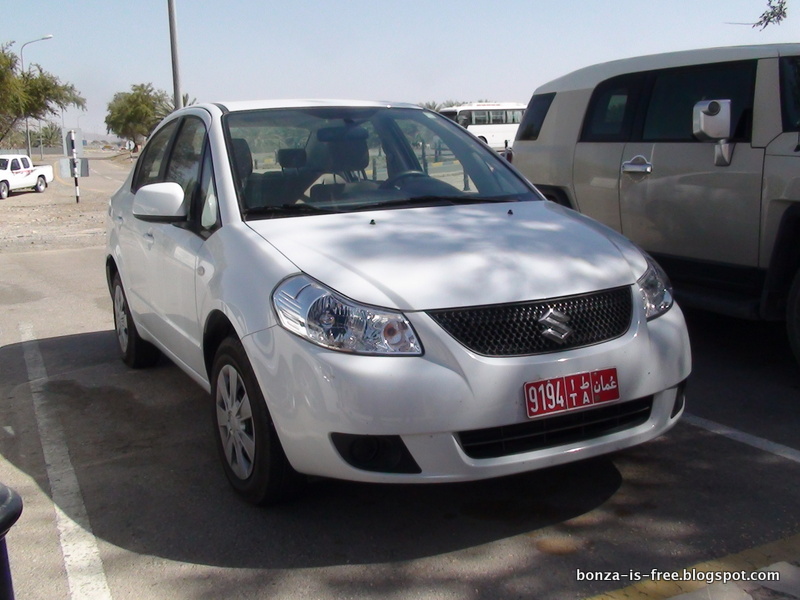 |
| The Suzuki that took me around Oman. I made it out without any dents! |
I'm glad to report driving in Oman was a pleasure. The drivers are certainly more civil than other countries in the region - just next door in the United Arab Emirates I live in fear as a pedestrian, let alone a motorist - and due to the low population once you're outside Muscat there is hardly any traffic on the expressways.
In racking up 1000km in five days I managed to visit three regions - Muscat, Nizwa, and Sur.
MUSCAT
 |
| Muttrah (Muscat): harbour in the evening |
In Muscat there is a glitzy, beachy part where all the luxury hotels and most of the tourists seem to be. I, of course, chose to stay in the old town - Muttrah; a beautiful harbour overlooked by old forts with a busy old souq (market), a lively morning fish market, and flanked by a lovely corniche.
 |
| Muttrah corniche |
SUR
Sur is a regional city close to the eastern tip of the Arabian peninsula. The newly built expressway from Muscat - which is so fresh the toll gates were not even manned - takes a gorgeous route along the coast. As strange as this sounds the scenery reminded me of Iceland; steep uninhabitable mountains on one side and the beautiful sea on the other, with the road wedged in between.
 |
| Ras al Jinz: newborn turtle shuffling to the sea |
 |
| Wadi Shab: entrance |
There were also tiny baby turtles, just hatched, making their perilous first journey out to sea. If it weren't for the fascinated tourists scaring off the circling seagulls I don't know how those vulnerable reptiles make it to the water without being gobbled up. It's a miracle that we have green turtles at all.
 |
| Wadi Shab: tourists swimming |
On the way back from Sur I visited the picturesque Wadi Shab. A Wadi is a river valley teeming with plant and animal life, and Wadi Shab is one of the finest examples of this type of oasis.
NIZWA
Nizwa was the ancient capital city of Oman, and these days is the major inland city. The Nizwa area is 150km inland, so again I enjoyed the view from driving. This time the terrain from Muscat was mountainous. Although the dry climate doesn't allow for lush plant life Oman does seem to have a lot of very steep and jagged mountains which are other worldly, as if a film set designer made them out of papier-mache.
The region around Nizwa is famous for its old castles and forts, plus it hosts some of the highest peaks in the country. I had hired a 2WD car so scaling the mountains was off-limits.
 |
| Jabrin Castle |
If one was ever curious about the Arabian peninsula I can highly recommend Oman. With decent roads only recently opening up the country it has yet to be completely trampled by tourists. At the same time it's very easy to get around - courtesy of the British meddling in their recent affairs English is widely spoken and attitudes towards women are progressive.
Moreover although it is now modern and affluent the country has still retained its sense of heritage with no tacky skyscrapers dominating its cities - a delicate balance to achieve for any government.
 |
| Omani bread with cheese and honey; samosas; saffron tea |
Alternating between Arabic and South Asian meals is my idea of nirvana, and my swollen belly departing Muscat airport certainly was testament to that.


